Frame Drums
Adventures with 'other' instruments...
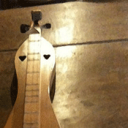
Looks like the head of one of those giant single string African banjos... Bob.
Looks like the head of one of those giant single string African banjos... Bob.
Hey thanks Travis!
I'll post more updates on this when I return from a mini vacation on monday. I'm currently on very limited computer time. 
Here is my cool frame drum... I am in awe of it . I have to say it's a bit intimidating due to its size, beauty, and resonance. It looks like a planet or moon.
Did my first practice session yesterday... could be worse i suppose, but there is a LOT to learn and coordinate!
Putting in the practice time is the key to improvement of course. Happily, it's more fun than frustration to practice on it, and Brian says he doesn't mind the sound drifting down the stairs at all. I'm pretty lucky in that respect! 
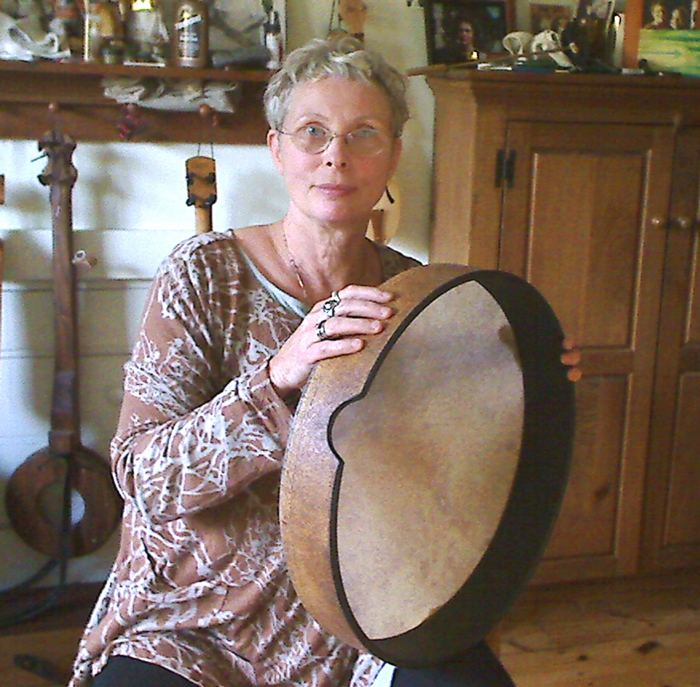
Oh my gosh...the 'Tar' frame drum arrived this afternoon!
---It's really beautiful. The Remo head is synthetic so will not sag in humidity (like my cheezy tambourines do), but they use a technique of somehow imprinting the head with a real photo image of goat skin- looks SO real, and has a nice texture like real dried hide. Even the sides are aged looking. Awesome!  I'll take a picture tomorrow to post here.
---It's pretty big...18" across. It sits vertically, on one knee while you play with one hand holding the top and the other hand doing most of the strokes. Has a very resonant nice tone, since it's tight. My arms are sore after just an hour's practice for the first time...to be expected I guess.
---After watching some Youtube lessons for the past few days, I knew some of the beginner moves to try out, and although I've never actually drummed before in my entire life and naturally don't sound good yet, I found it was still tons of fun to try the different tone effects in combination. There is a lot of variety in sounds one can get using your hands on a frame drum like this. Even Brian was surprised at the different sounds coming from upstairs after just an hour.
I'll be needing to do LOTS of practice, since I've never done any real drumming before- I pretty much still stink at it. But wow, so much fun, I didn't expect it to be so fun! That'll make practice very enjoyable.

Good advice, thanks Skip and JohnHenry!
I imagine it'll be a while, if at all, that I manage to get a bit of control and sound like anything. I was amazed at how many great free youtube lessons there are out there for frame drums, and I can just play slowly along to whatever tunes I punch up on my computer- the advantages of living in the hi tech age! I'll be using my hand rather than a tipper/beater stick, so that may make the volume more controllable. I ordered a "Tar" rather than a bodhran. It will be shallower depth than most bodhrans I think. But it 18" diameter, so fairly large..best to be held vertically on the lap while sitting I think- thats what most people do with that size frame drum.
I've had a couple of cheap tambourines sitting around for a couple of years, but still can't play them very well. But maybe if I practice on this Tar enough, it'll eventually help my tambourine playing as well...might make sense. I'd love to be able to play a decent tambourine when in minstrel banjo gatherings. Always good to have musical options in various playing situations!
I have three Bodhrans ! Before coming back to the MD I played HD for many years in all sorts of sessions, and found it convenient to have a drum by my side to 'bridge the gap' when tunes arose that I could not cope with. I did'nt always use a 'tipper', quite often relied on the fingers of my right hand ,and frequently used a 'brush' type beater, offers a softer option ? And of course you can always 'dampen the sound, your hand , duster ,tea towel, knick...whoops !
Main thing to remember, you may think your timing is great, others may not ! Softly ,softly catches monkee !
JohnH
I've had a bodhran for several years. I use it at a couple of jams I go to. I prefer playing it with others rather than my dulcimers. I was a bit concerned about taking it at first, but now most of the folks want it because it helps with timing [metronome effect]. The biggest problem I had was being too loud. I don't play it very well but that doesn't matter, it's fun and it really has helped keep the groups together, specially the speed demons in the HD group. I just recently bought a cheap tamborine to mess around with. Now I can have jingles along with a very small drum. :>)
Ok, so I recently ordered myself a "Tar" -a frame drum based on those from North African and Middle Eastern cultures. It should arrive in a couple of days. Thank goodness for Youtube beginner videos, that's all I can say...lol. Not sure what I'm in for, or whether I will have any sort of success. It might be that all I do is annoy Brian and the cats, and become shunned in my own house. But I'm game to find out!
Frame drums are single-headed hoop frame drums. The smaller ones are often hand-held while the larger ones can be held vertically on the lap. Their head diameter is wider than the hoop is deep. In most cultures they are played with the hand, though Irish bodhrans are typically played with a tipper or beater.
Anyone else here who plays frame drums?- please share! As a total drum beginner, I'd love to hear about what you do with your frame drum.
P.S. I was partly inspired to 'go for it' by member Helen of Australia, who recently bravely agreed to share with us her beginning adventures with a didgeridoo !
Hi Tumble,
Whatever you do in private is your decision, and is not the responsibility or concern of this site. Just please do not discuss or arrange such exchanges publicly here, as our site does not encourage or condone copyright infringements.
Thanks for asking!
Ok now I have a new question:
I know sharing publicly on this or any other website written tab for a song is a big NO NO if it is still registered with ASCAP or BMI but if I figure out on my own MD tab for a newer song and share it through private email with another MD player friend is that going to send me to the calaboose?
Hi Cyntia! The whole album is so beautiful. It's hard to choose a favorite, but I suppose the stand out tracks for me were: I Sing Praise to Brigit, Miner's Dance and Lucina's Lullaby. It's definitely a lovely album. The arrangements, the production and the performances are so exquisite.
It's called "Soul Tending." It's absolutely gorgeous! Highly recommended!! I just got it, and can't stop listening.
It would help to know what the acronym NGFDA stands for.
Hi! Yes. DAD you are tuned to the key of D mixolydian, and if you have a 6.5 fret you can also play in the key of D major (AKA D Ionian). In DAD you can also play in the Key of G Major pretty easily using your 3rd fret as your tonic (home base). But if you are using a noter drone style of playing, then you will want to tune to DAA if you want to use your 3rd fret as your tonic in the key of D, but if you are chording, then there is no need to retune.
Tumbleweed, "Blowin' in the Wind" can definitely be played on a diatonic fretboard, and the vast majority of Hank Williams tunes can, too. If you need help figuring out a particular part of a song, why not ask for help in the Help Me Learn this Song group? Start a new discussion including the title of the song and explain the part you can't figure out. I'm sure another FOTMD will help out.
Just one minor point of clarification. If you are tuned DAd, your dulcimer is indeed in an open D tuning. However, if you play chords and fret across all the strings, it is possible to play in other keys out of that tuning. Bm is the most obvious, but there are lots of arrangements in G out of the DAd tuning, and it is also possible to play well in A. (Gary Gallier has developed a whole bunch of arrangements in A out of the DAd tuning, something he calls "cross key" after the way blues harmonica players plays blues on a harmonica that is technically a fourth below the key they play in.) You cannot play noter/drone in these other keys since the drone strings are locked in the open tuning.
Your question about that "one little note" that you can't find is probably not a matter of keys, but, as Ken indicates, of modes. The dulcimer has a diatonic fretboard, meaning not every note is possible. If you are indeed playing "newer songs" those songs may not be written in the traditional modes. You might be able to find that "one little note" on a string other than the melody string, and you might be able to find it by bending a string. But just changing keys won't really help.
Hi Tumbleweed;
Tuning/Key-- yes, if you are tuned DAd you're in the key of D, as we say. The dulcimer's keynote is D. If you are tuned CGc you are in the key of C and the dulcimer's keynote is C. In both cases you are tuned to Mixolydian Mode.
If you "can't find a note" changing the key may help. Remaining in the same key, but changing the modal tuning may also help. A tune like Star of County Down can't be played properly (it can be faked, with varying degrees of success) in DAd or DAA tuning, but is played perfectly simply in DAG -- Dorian Mode key of D. Each Mode has a slightly different scale, not the usual Do, Re, Mi that you can play in DAd or DAA with/without the 6+ fret.
Hi Everybody:
I have search the site and read a few posts but I still have a question that I am sure has been asked many times before so here it goes:
I understand the difference between keys and modes but don't have a lot of music theory. If I am tuning to DADD am I in the key of D? If I am tuned to CGCC am I in the key of C? I like to learn new songs in noter style and sometimes have to figure it out by ear as there are no tabs for newer songs that I want to play. Once I am proficient I like to spice it up with chords. I am doing alright mostly until I get to just one little note in one area of a song and can't seem to find the right note. If I tune to another key would I fix the problem? Sometimes I have to dip down but this doesn't always solve it. Any responses will be appreciated but I don't have a lot of music theory terminology in my vocabulary so y'all may need to speak in simple terms for me. Thanks for reading.
TW
A varient of that picture is in Bonnie Carol's "Fingerdances for Dulcimer" book, but it says it's from 1979. Doug Berch and Marc Nelson should be in there somewhere. I believe Joellen Lapidus is beside Kevin Roth. Fred Meyer could be on pur left of Alan. Of course Bonnie Carol is on the far right, second from the bottom.
I believe that 2 of my then dulcimer students--Robin Mohun and Gail Larsen--went to this festival and had a very good time!
Peter
Sorry, I meant to say "Dulcimer History", I have Bowed Psaltery on my brain constantly.
Was just told Robert Force is on the right looking at the picture. Hei just below and to the right of the guy in orange t -shirt and blue shorts. This cool hope we can name some more.
Gregg, I thought this was a cool picture and there would be some who recognized a few folks. Thanks for posting some of the names. Maybe a reunion of some of these folks could happen.
Two people to the left of Hubbert is Leo Kretzner standing next to David Beede standing next to Kevin Roth. Directly above Beede is me Gregg E. Schneeman, wearing my fur lined knit cap holding up my Bowed Psaltery and my Mushroom Headed Dulcimer you see in my FOTMD profile picture. That was a significant moment in Bowed Psaltery History and I am proud to have been there.
Found this and wondered if there might be any FOTMD members in this picture.
https://www.facebook.com/photo.php?fbid=10203580035116097&set=a.2348861075588.2123751.1071924118&type=1&theater
Thank you all for this. I looked on both sites for the Stew-Mac kits and they were never mentioned. It's probably food to have this up somewhere so others can reference it. I like the David Lynch idea. Really appreciate you guys commenting, it's just amazing how quickly the info showed up! I hope I can help others out too as I get more into this.
You could also consider the "Sweet Song" kits from McSpadden. I've made several, and they all turned out very nicely.
stew/mac kits have been made by folkcraft for years. they are good kits
Cynthia, I took a look and read the instructions at the Stew-Mac website.
http://www.stewmac.com/Materials_and_Supplies/Kits/Dulcimer/Dulcime...
It appears that Stew-Mac is reselling the Folkcraft Walnut Kits since the instrucktions are labeled Folkcraft. The Ratings and Reviews on the Stew-Mac are mixed (overall 3.5 out of 5).
If I were going to have someone build a kit for me, I would have him look at both the Stew-Mac and Folkcraft sites to make a final decision. Here is the Folkcraft link.
http://www.folkcraft.com/appalachian-dulcimer-kits.html
If you are looking for your first dulcimer, I would recommend a student dulcimer from our member, David Lynch.
http://www.strothers.com/sweetwoodsinstruments.com/index.html
This is only my humble opinion and I hope that others will chime in. Welcome to FOTMD, Cynthia and enjoy the journey in the wonderfull world of the mountain dulcimer.
Dan
Someone has offered to build me one of these who has built beautiful guitars before but wants experience building a dulcimer from a kit. He said that if I bought the kit he would build it, but I can't find anyone who knows anything about this kit. If he is willing to build a decent dulcimer for me, I'd like to get a great kit that he could feel good about too, good instructions, quality materials etc. So, does anyone anywhere have any experience with this particular kit? Thank you for reading this.
An additional note to add to Ken's explanation - I always tab for both D-A-dd and D-A-AA for our dulcimer club tunes ,but I always show tab for all three strings, even though all of our tunes can be played on just the melody string or with chords, as desired. This is the first time I've seen tab like this, with only the top two strings shown for each. I can't say I get around very much, but in my experience this isn't a very common tab style.
In a comment on my I Just Got A Dulcimer, Now What? blog, Evy Bush asked:
I understand how to read all the tablature except the ones that are set up like this one where you can choose between DAD or DAA.
I just can't make sense of which strings are which because any way I look at it they don't fall in order. Can anyone explain this for me? Thanks! I, sure it is something very simple that I am somehow missing.
Here's a link to an example: http://www.everythingdulcimer.com/tab/amazingddul.pdf "
The subject comes up fairly often so I thought I'd answer publicly, so others can benefit.
The link is to Amazing Grace posted by RLWalker:

The top two lines, marked AD are for those who are tuned to DAd, and represent what you, the player must fret on the Ad strings of the DAd tuning.
The bottom two lines: DA, are for those tuned in DAA, and show you what to fret on the A melody string of the DAA tuning.
This particular illustration is the perfect example of how to "convert" DAd tab to DAA and vice versa. If you have DAd tab and want to play in DAA, simply add 3 to the d melody line numbers and play the new numbers on the A melody line in DAA. If you run into a 6+ fret notation in DAd, play that as a fret 9 in DAA.
"Ooh that dulcimer has a mean tone!" 
Jerry says above that "it is not always possible to have on fret go across the fingerboard," but many luthiers are recognizing that and are making "true tempered" fretboards that look real funky:
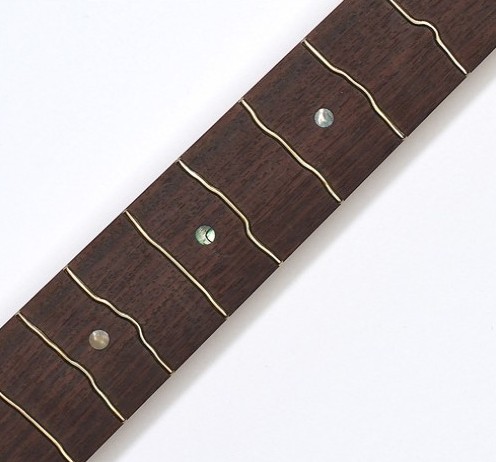
You can find out more at True Temperament Fretting System .
As Dusty Turtle say, this is NOT a dumb question!! It is a question which opens up many doors, and once you start opening the doors, you will have more and more questions. This is basically the large field of "Tunings and Temperaments" or sometimes referred to as "Microtunings" or "microtonality" -- basically all pointing to the whole idea of notes in between the keys of a piano (or smaller than a half-step).
There is some great discussion here, and many of you seem to have a good handle on the overall, general ideas of where frets might go. I particularly resonate with the single string stretched across a board of some sort, where you map out the divisions of the string - which will give you the harmonic series. If you get the harmonic series: dividing a string into 2 (2nd harmonic), 3 (3rd harmonic), 4 (4th harmonic), 5 (5th harmonic), 6 (6th harmonic), 7 (7th harmonic), and so on----then you can see how easy it is to build a just-intonation scale based on VERY simple small-integer ratios:
1/1 - 9/8 - 5/4 - 4/3 - 3/2 - 5/3 - 15/8 - 2/1
These would correspond to the frequency ratios of C - D - E - F - G - A - B - C ---- if you want fret spacing for your dulcimer's bass string (this is for 6+ fret only here - computing the normal 6th fret is another ballgame), you would use the inverse of these (frequency is inversely proportional to string length), remembering that the string length is the distance from each fret to the Bridge. To get your distance from the nut to a fret, just subtract that from the open nut-to-bridge V.S.L.
Another very important thing to remember on the dulcimer is that -- in C - G - G (1 - 5 - 5 Ionian) Tuning, the middle and melody strings will NOT go up EXACTLY as the bass string, because they are tuned to the 5th of the scale (so you start from 3/2 at the nut on these strings, and this time you will have the natural 6th fret and NOT the 6+). So, I'm basically saying here that it is not possible ALWAYS to have one fret go all across the fingerboard like they do on guitars, banjos, and modern dulcimers.
The wikipedia entry on just intonation is superb on deriving all this:
I really need to get around to making some sort of an adjustable-fret dulcimer -- individually adjustable frets for each string. Of course one way around this is to use bagpipe tuning 1 - 8 - 8 (I know this works well for just tuning because my 1966 Jethro Amburgey is pretty close to just tuning and bagpipe tuning ROCKS on this!). Sorry about all the detail and ratios, but it really comes down to this kind of stuff, and there are many, many worthwhile web sites to help you get it.
I may be able to answer your questions, or at least I may be able to point the way to some good web resources. Thanks for the great thread!! BTW, I'm a major fan of Equal Temperament, mostly because I play a lot of chords and want to be in tune with keyboard synthesizers.
And by the way, this is not a "dumb question" at all but in fact a very complicated one that involves mathematics, acoustics, and other sciences about which most musicians (including wannabees like myself) are entirely ignorant.